|
1. Straw Suits Some Cows!
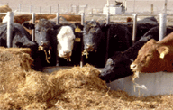
In a study designed to investigate ways to reduce winter feeding costs, researchers fed cattle ammoniated straw. During the 3-year trial, 32 cows - 5 to 8 years of age - were fed straw from December to May. Some cows performed poorly, while others maintained themselves on the diet. Why did some cows perform so poorly?
 A. They are genetically less efficient than the cows who performed well on straw. A. They are genetically less efficient than the cows who performed well on straw.
Not quite. While genes can play into what an animal eats, learning is a much more powerful force.
B. The straw didn't taste good to them.
Not quite.
Taste is determined by the nutrients and toxins in the food. Though straw contains few nutrients, ammoniated straw contains nitrogen which the cows can convert into protein. Thus, it does provide them with positive feedback. For more hints on the real reason go here.
C. The cows who performed well had previous experience with ammoniated straw
EXACTLY! Here's the whole story:
To reduce the cost of ranch operation, researchers and producers in the western U.S. are exploring ways to feed low-cost foods like straw to livestock during winter. During a 3-year study, 32 cows 5 to 8 years of age were fed ammoniated straw from December to May. Some cows performed poorly, while others maintained themselves. Researchers were baffled until they examined the dietary histories of the animals. Half of the cows were exposed to ammoniated straw with their mothers for 60 days during their first 3 months of life, while the others had never seen straw. Throughout the 3 year study, the experienced cows maintained higher body condition, produced more milk, lost less weight, and bred back sooner than cows with no exposure to straw as calves, even though they had not seen straw for five years.
The point of this example is simple to understand, but easy to overlook. Experiences of young animals have lifelong influences that affect the efficiency and profitability of production systems. Animals' histories must be considered if we wish to improve the efficiency of agricultural production, the welfare of livestock, and the well-being and profitability of managers. Young animals cope with change more readily than adults because their food and habitat preferences are more flexible. Thus, exposing young animals with their mothers to a variety of foods and locations, expecially those they will experience later in life, can lessen problems with transitions.
 |
2. Moose Migrate Uphill!
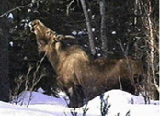
Contrary to the general pattern of migration, a population of moose in central Norway migrate from low-lying summer areas to high-elevation winter areas. Archeological evidence shows they have done this for thousands of years even though they are heading to poor quality winter range. Why do these moose migrate up hill?
A. All the people live in the lowlands so there's nothing for them to eat down there.
Not quite. Though the reason moose are migrating uphill originally had something to do with people, it's not the reason they've done it for 5000 years.
B. Because they learned it from their Moms.
YES!! Here's the whole story:
Archeological evidence suggests the moose were once hunted (pit trapped) in the low lying areas. So moose began migrating uphill to avoid hunters. Their situation is hardly ideal and the effects of their poor winter range is reflected in low calf production of 0.6 calves/cow as compared the .8 to 1.3 calves/cos of neighboring populations. Still the moose don't change because they manage to continue to suvive. Changing migratory routes to access better quality range may take many generations, if it ever occurs.
Producers who would like to change pasture and range use by their animals might keep the moose's stubborness in mind. It is sometimes easier to cull individuals who do things you don't like than it is to change their minds.
C. Their front legs are shorter than their back legs so it's easier for them to walk uphill than downhill.
I don't think so . Though we haven't measured their legs, this doesn't seem reasonable. While it would make it easier for them to migrate uphill in the winter, it would make it really difficult for them to come back to the low-lying areas in the summer-time. I imagine herds of moose overbalancing as they try to walk downhill with their short front legs, and tumbling over and over until they arrive in their summer pastures.
3. Cows Don't Eat Grass!
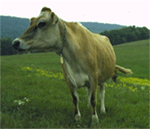
To reduce the high cost of feeding lactating dairy cows in confinement, many producers are using intensively managed pastures as a source of low-cost, high-quality forage. However, dairy cows reared in confinement perform poorly on pasture. Upset, perplexed producers report that cows don't eat grass and milk production plummets. What's going on?
A. Because they've never seen grass before, it doesn't look like food to them.
Very Good! For a dairy cow reared in confinement, the barn is habitat, ingredients from a total-mixed-ration are food, and water comes in a trough. Although they may be quite hungry, they lack the experience that would tell them that what they are walking on is really food, and they haven't developed the skills to eat grass. No wonder they stand at the gate and bellow to be fed!
Extra Credit: What would a dairy farmer do to ease his herd's transition to pasture?
B. They are spoiled, picky eaters and if you just starve them, they'll eventually get the picture.
Probably Not.... It is true that being spoiled and picky are two ways to describe how an animal behaves as a result of its experience. If left in the pasture long enough, the cows will likely begin to check out the new foods in their strange environment. However, in the interim, their productivity will decline. In addition, as you'll read in the Old Dogs - New Tricks section, starving an animal is the least successful way of introducing animals to new foods and environments.
C. Dairy cows were never supposed to eat grass.
Now you're pulling my leg! I know you don't really think this. You were just coming here to see what sound we'd play!
4. Is it in the Genes?
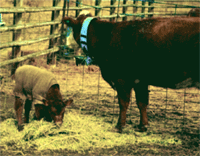
Two herds of cows each have their preferred range. This calf comes from a "Maxfield" range mom, but is being raised by a Thompson Creek Cow. Which range will this calf be more comfortable in?
A. He'll prefer the home range of his biological mother because he's genetically more suited to that terrain.
Not Really.... People often believe that heredity is the foundation for animal behavior. While it can be important, it is not the only thing we should consider.
B. He'll prefer the home range of the cow raising him.
Exactly Right! Here's the rest of the story:
The first year calves were still nursing so they preferred the habitat their mothers preferred. In year two of the study, peers affected habitat selection, especially as yearlings because all heifers were housed together as a group during the winter to receive supplemental feed. In year 3, drought also affected habitat selection because Maxfield creek dried-up causing cattle that preferred Maxfield drainage to enlarge their home range in order to water. By year 4, when water conditions returned to normal calves preferred the home range they had been raised on as calves. Maxfield cows returned to their former home range, and Thompson Creek cows returned to their former home range.
Thus, while nature plays a part in an animal's behavior, nuture, or experience when young, can determine how the animal evolves.
C. He'll never leave the pen because he's too embarassed to be seen in that silly coat.
Not Quite! We really have no evidence that collars, coats or bandannas on animals affect their self-esteem or how they select their home range. Therefore, this isn't a likely answer.
Finally -
 |
| Click to see a 25 second video - 1 mb |
|
5. If goats can eat ANYTHING, what's wrong with this one?
A. He's suffering from a rare chewing disease.
Not Quite....There are chewing diseases, and some of the them are associated with eating plants with certain toxins. But this is not the case for the goat in this video.
B. He's not trying to eat. He's flossing his teeth.
You've got it....Wrong! Yes, goats are as smart as many humans, but they lack our hygiene concerns.
C. He's never seen that plant before so he hasn't yet learned the foraging skills it takes to eat it.
Hooray! Yes! This is the goat's first experience with blackbrush and he just doesn't have the technique down yet. Many animals have to learn the techniques for eating new and unusual foods. As you'd guess from everything you've read so far, they learn best from their mothers, but can also learn from other experienced animals.
You've finished a meal! Congratulations!
|